• The Power of Flow State and How To Access It

    In neuroscience, the concept of ‘flow’ is currently a popular topic in the field. Flow describes a specific mental state that allows us to focus intensely on a single task or subject matter.

  • The Three Things you Need to Make Peak Performance

    James Arthur Lovell, Jr., one of the first American astronauts to fly and orbit the moon once said, “Be thankful for problems,​​ if they were less difficult, someone with less ability ...

  • On Reading Between The Lines ...

    What it actually means is this: figuring out the real message, the hidden implication, the unspoken subtext of something, based on subtle clues rather than the words that are plainly stated.

  • How To Stay Calm In the Storm ...

    The storm is all around us. The Coronavirus COVID-19 disease which was declared a global pandemic by WHO has an alarming fatality rate and it instills fear and panic in our daily lives.

  • A Prayer For Wisdom

    This prayer is quoted from the Bible in the book of Wisdom 8:17-21; and Wisdom 9:1-18 NLT (New Living Translation: Catholic Edition).

Tuesday, December 31, 2024

The Greatest Glory in Life, Lies in Rising Every Time We Fall


The Greatest Glory in Living Lies Not in Never Falling, But in Rising Every Time We Fall


Chatham House, CC BY 2.0 via Wikimedia Commons: Nelson Mandela at the 'South Africa: The opportunities for business' conference, Chatham House, 2014.

Why Nelson Mandela's Most Famous Quote Is Still the Most Powerful Thing You'll Read Today

Let's be real for a second. We've all seen those motivational posters hanging in dentist waiting rooms — the ones with a soaring eagle and some vague caption about "believing in yourself." They're about as inspiring as watching paint dry on a Tuesday afternoon. But every now and then, a quote comes along that genuinely stops you in your tracks, makes you put down your coffee, and think, "Wait. That's actually profound."

Nelson Mandela's timeless words — "The greatest glory in living lies not in never falling, but in rising every time we fall" — are exactly that kind of quote. Not the eagle-poster kind. The real kind. The kind that sticks to your ribs like a good meal and refuses to leave your brain for days.

This isn't just a catchy line somebody slapped onto a sunset photo. It's a philosophy. A blueprint. A way of looking at life that completely flips the script on what success is supposed to look like. So buckle up, because we're about to dig deep into one of the most meaningful ideas ever put into words — and we're going to have some fun doing it.


What Does the Quote Actually Mean? (No, Really.)

Before we go all philosophical and start waxing poetic, let's break this down like we're explaining it to a friend over coffee.

The quote is fundamentally saying this: glory — real, genuine, soul-deep glory — doesn't come from having a perfect, failure-free life. It comes from getting knocked flat on your face and choosing, every single time, to get back up.

Now, that sounds simple enough. But sit with it for a minute. Because what Mandela is really challenging is one of the most deeply held assumptions in modern culture: that success is about avoiding failure. We're taught from an early age to get it right. Don't make mistakes. Don't embarrass yourself. Don't fall.

But here's the thing — life doesn't care about your plan. Life is going to trip you up whether you're ready or not. The question is never if you'll fall. It's always what you do after.

The quote redefines success entirely. It shifts the trophy from the person who never stumbled to the person who stumbled a hundred times and kept going anyway. And honestly? That's a much more interesting person to root for.


The History Behind the Words: Mandela's Falls Were Literal

It'd be easy to dismiss this quote if it came from someone who'd lived a comfortable, challenge-free life. But Nelson Mandela didn't just talk about falling and rising — he lived it in one of the most extraordinary ways any human being ever has.

Mandela spent 27 years in prison. Twenty-seven years. For context, that's longer than many people's entire adult working lives. He was imprisoned for fighting against apartheid, a system of racial segregation so brutal and unjust that the rest of the world eventually looked on in collective horror.

Most people, faced with that kind of fall — that kind of devastating, crushing, identity-stripping collapse — would break. And who could blame them? But Mandela didn't just survive his imprisonment. He emerged from it with his convictions intact, his humor reportedly still sharp, and a vision for a better South Africa burning brighter than ever.

He went from prisoner to president. That's not a metaphor. That's the world's history.

When Mandela talks about rising every time we fall, he's not speaking theoretically. He's speaking from the kind of lived experience that most of us will never fully comprehend. And that's exactly why the quote carries so much weight. It didn't come from a motivational speaker with a podcast and a Patreon crowdfunding account. It came from a man who suffered immeasurably and still chose — again and again — to rise.


Why We're So Terrified of Falling (And Why That Fear Is Holding Us Back)

Here's an uncomfortable truth: most of us are more afraid of failure than we are excited about success. We dress it up in different clothes — we call it "being realistic," or "managing expectations," or "playing it safe" — but underneath all of that, it's just fear.

And fear of failure is extraordinarily sneaky. It doesn't always show up as paralysis. Sometimes it shows up as perfectionism. You don't start the business because you haven't figured out every detail yet. You don't write the book because what if it's not good enough? You don't apply for the job because what if you don't get it?

Meanwhile, life ticks by. And the thing you were afraid of failing at remains undone.

Psychologists call this "fear of failure" or atychiphobia in its clinical form, and it's remarkably common. Studies have shown that fear of failure can be more motivationally paralyzing than fear of pain. Think about that. Some people would rather hurt than fail. That's how deeply we've internalized the idea that falling is shameful.

Mandela's quote is a direct antidote to this kind of thinking. It doesn't pretend that falling doesn't hurt. It doesn't minimize the embarrassment, the loss, the sting of a dream that didn't work out. Instead, it says: all of that is okay, as long as you get up. The fall doesn't define you. The rising does.


The Science of Resilience: Why Rising Again Is Actually Good for Your Brain

Now let's get a little nerdy, because it turns out that resilience — the psychological ability to bounce back from adversity — is one of the most well-studied traits in all of human psychology, and the research is genuinely fascinating.

For a long time, scientists thought resilience was a fixed trait. You either had it or you didn't. Some people were just born tougher, and the rest of us were destined to crumble under pressure. Comforting, right? Not even a little.

But more recent research has completely overturned that assumption. Resilience is a skill. It can be learned, practiced, and strengthened — just like a muscle. And the more you exercise it (i.e., the more times you fall and choose to get up), the better you get at it.

Dr. Martin Seligman, the founder of positive psychology, spent decades studying what makes people bounce back from adversity. His research found that resilient people share certain cognitive habits: they tend to see setbacks as temporary rather than permanent, specific rather than universal, and external rather than entirely self-caused. In other words, instead of thinking "I failed because I'm a failure and everything is ruined forever," they think, "That didn't work. Let me figure out why and try differently."

That's it. That's the whole game. The story you tell yourself about your failure determines whether you rise or stay down.

And here's the kicker — every time you practice rising, you literally rewire your brain. Neuroplasticity means that the neural pathways associated with resilience become stronger and more automatic the more you use them. Falling and rising isn't just philosophically good for you. It's neurologically good for you.


Real-World Examples of People Who Rose (and Kept Rising)

Let's take a quick tour through history and recent times to look at some people who clearly read the Mandela playbook — even if they'd never heard the quote.

J.K. Rowling was a single mother on welfare, clinically depressed, and had her Harry Potter manuscript rejected by twelve different publishers. Twelve. That's not a stumble. That's a faceplant into gravel. Today, she's one of the best-selling authors in human history. In 2004, Forbes magazine named J.K. Rowling "the first billion-dollar author". The fall didn't stop the story. It was part of it.

Thomas Edison famously failed thousands of times before inventing the lightbulb. When a reporter asked him how it felt to fail so many times, he reportedly said he hadn't failed — he'd just found ten thousand ways that didn't work. That's either genuine genius or the world's most impressive spin, but either way, the man kept rising.

Oprah Winfrey was fired from her first television job as a news anchor and told she wasn't fit for TV. We'll pause here for the irony to fully sink in. She went on to build one of the most powerful media empires in the world. Globally, she is the richest Black woman and the wealthiest female celebrity. Dubbed the "Queen of All Media", she was the richest African-American of the 20th century and was once the world's only Black billionaire. By 2007, she was often ranked as the most influential woman in the world.

Steve Jobs was actually fired from the company he founded. Pushed out of Apple — his own baby — in what must have been a humiliating, ground-shaking fall. He came back, rebuilt, and under his second tenure gave the world the iMac, iPod, iPhone, and iPad. Not a bad second act.

What do all of these people have in common? They fell — publicly, sometimes spectacularly — and they got back up. Not because they weren't hurt by the fall, but because they refused to let it be the end of their story.


How to Actually Rise: Practical Wisdom for the Real World

Okay, so we've established that rising is good, resilience is learnable, and history's greatest achievers all have a solid falling-and-rising track record. But what does rising actually look like in practice? Because "just get back up" is great advice in theory, but a little thin on specifics.

Here's how to actually do it.

First, let yourself feel the fall. This sounds counterintuitive, but trying to immediately bounce back without processing what happened is like putting a bandage over a wound you haven't cleaned. You need to feel the disappointment, the frustration, the grief — whatever it is — before you can move through it. Suppressing those emotions doesn't make you stronger. It just means they'll ambush you later.

Second, get brutally honest about what went wrong. Not in a self-flagellating, "I'm the worst person alive" way, but in a clear-eyed, practical way. What didn't work? What could you have done differently? What was outside your control? This is the debrief stage, and it's where you extract the actual lessons from the experience instead of just suffering through it pointlessly.

Third, reframe the narrative. This is where Mandela's quote becomes your mental wallpaper. You are not someone who failed. You are someone who tried, encountered an obstacle, and is now smarter, tougher, and more experienced than you were before. That's genuinely true, by the way — not just motivational fluff.

Fourth, take one small step. Rising doesn't mean immediately soaring. Sometimes it just means standing up. Taking one small, concrete action in the direction you want to go. The momentum builds from there.

Fifth, surround yourself with people who believe in rising. Energy is contagious — both the good kind and the bad kind. People who catastrophize every setback will make your falls feel bigger and your rises feel harder. People who've fallen and risen themselves will remind you that it's possible.


The Connection Between Falling and Growth: You Can't Have One Without the Other

Here's something nobody tells you when you're young and terrified of failure: falling is not the opposite of growth. It's the engine of growth.

Think about literally anything you've ever gotten good at. Did you learn to ride a bike without falling off? Did you learn to cook without burning something? Did you learn to have healthy relationships without messing a few of them up along the way? Of course not. Mastery comes from practice, and practice involves getting things wrong before you get them right.

The Japanese have a concept called "kintsugi" — the art of repairing broken pottery with gold. The idea is that the cracks, filled with gold, make the piece more beautiful and more valuable than it was before it broke. The breakage is not hidden. It's celebrated as part of the object's history and character.

That's what Mandela's quote is really pointing toward. Your falls, your failures, your cracks — they don't diminish your value. Properly processed and integrated, they add to it. They're the gold in the pottery. They're the depth behind the eyes of someone who's really lived.

People who've never fallen often have a certain brittleness to them — a fragility that comes from never having been tested. They can be shattered by the first real adversity they face because they've never built the muscle. The people who've fallen and risen? They have a groundedness, a steadiness, that can't be faked and can't be bought. It can only be earned through the exact process Mandela describes.


Falling in the Age of Social Media: The Extra Complication Nobody Asked For

Now let's talk about the particular challenge of falling in 2024 and beyond, because we have an extra complication that Mandela didn't have to contend with: we fall in public now.

Social media has created a world where people curate highlight reels of their best moments and post them for the world to see, like, and validate. And when you're watching everyone else's curated perfection, your own messy, imperfect reality can feel like a catastrophic failure by comparison.

The comparison trap is real, it's relentless, and it's spectacularly unhealthy. Research consistently shows that heavy social media use correlates with increased anxiety, depression, and — you guessed it — fear of failure. Because when falling feels like it happens in front of an audience, the stakes feel much higher.

But here's the thing: everyone is falling. The people with the perfect Instagram feeds are falling too. They're just not posting about it. Behind the polished photos and the carefully crafted captions, there are failed businesses, broken relationships, abandoned dreams, and 3 a.m. moments of existential doubt. The falls are happening. They're just invisible.

Mandela's quote is a powerful corrective to the social media illusion. The greatest glory doesn't come from performing a perfect life. It comes from living a real one — complete with its stumbles, its setbacks, and its sometimes ungainly, imperfect attempts to rise.


Teaching the Next Generation to Rise

One of the most important applications of this philosophy is in how we raise and educate children. If we want the next generation to be resilient, we need to stop trying to protect them from every fall.

There's a phenomenon that child psychologists have observed in overly protective parenting — sometimes called "helicopter parenting" — where children are shielded from so many natural consequences and disappointments that they never develop the emotional toolkit to handle adversity. Then, when the real world hits them (and it will), they have no idea what to do to overcome it.

The greatest gift you can give a child is not a fall-free life. It's the confidence that they can survive a fall. That means letting them fail sometimes. Letting them feel the disappointment of not making the team, or not getting the grade, or losing the game — and then helping them process it, learn from it, and try again.

This doesn't mean being indifferent to a child's struggles. It means being present and supportive during the rising, rather than trying to prevent every fall. Teaching kids that failure is survivable — even instructive — might be the most important lesson any parent or educator can impart.


The Spiritual Dimension: Falling and Rising Across Traditions

It's worth noting that Mandela's insight isn't unique to him or to modern philosophy. The idea that meaning and glory come through struggle rather than ease is one of the most universal themes in human spiritual and religious thought.

Christianity speaks of death and resurrection, of the grain of wheat that must fall into the ground and "die" before it can bear fruit. Buddhism teaches that suffering is inherent to existence, and that wisdom and liberation come through working with that suffering rather than running from it. Stoic philosophy — increasingly popular today — holds that adversity is not the enemy of a good life but one of its essential ingredients.

Joseph Campbell's concept of "the hero's journey" — which underlies virtually every compelling narrative humans have ever told — is built entirely around this idea. The hero doesn't achieve glory by avoiding the dark forest. The hero achieves glory by entering it, facing the monster, and emerging transformed. The fall — the descent, the trial, the darkness — is not an interruption of the hero's story. It IS the story.

Mandela's quote, in six words, captures something that storytellers, theologians, and philosophers have been circling around for millennia: the rising is what makes us.


Conclusion: Your Falls Are Not the End of Your Story

Here's where we land, and let's make it count.

The greatest glory in living lies not in never falling, but in rising every time we fall. These aren't just beautiful words. They're an instruction manual for a meaningful life. It insists that - failure is not final.

You're going to fall. Maybe you already have — recently, badly, in ways that still sting when you think about them too long. Maybe you're in the middle of a fall right now, wondering if you'll ever find your footing again. That's okay. That's not the end. That's actually, believe it or not, part of the glory.

The glory isn't reserved for people who had it easy. It's not for the ones who were never tested, never doubted, never lay awake wondering if they'd made a terrible mistake. The glory — the real, hard-won, soul-deep kind — belongs to the ones who fell and got up. Fell and got up. Fell and, even when every bone in their body screamed to stay down, got up one more time.

That's the story worth telling. That's the life worth living. And that's the kind of human being the world genuinely needs more of.

So go ahead. Fall if you need to. Just make sure you rise again.

Share:

Saturday, June 1, 2024

The Best Time to Plant a Tree Was 20 Years Ago....

The Best Time to Plant a Tree Was 20 Years Ago. The Second Best Time Is Now.


Photo by Anna Shvets on Pexels

There's an old Chinese proverb that's been floating around motivational posters, LinkedIn feeds, and the walls of every life coach's office since the dawn of time: "The best time to plant a tree was 20 years ago. The second best time is now." You've probably seen it so many times that it's started to feel like wallpaper — decorative, familiar, and easy to ignore. But here's the thing: just because something shows up on a motivational calendar doesn't mean it's wrong. In fact, this particular nugget of wisdom might be one of the most quietly profound pieces of advice ever condensed into a single sentence.

So let's dig into it — literally and figuratively — and figure out why this proverb hits differently than your average fortune cookie wisdom, and why it might just be the mental reset you didn't know you needed.


What the Heck Does Planting a Tree Have to Do with Your Life?

Let's start with the obvious question. Why a tree? Why not "the best time to bake a loaf of bread was 20 years ago"? The answer, it turns out, is beautifully intentional. Trees are one of the few things in the natural world that embody the concept of delayed gratification in a way even a five-year-old can understand. You plant a tiny seed, you water it, you tend it, and then — after years of patient effort — you get shade, fruit, oxygen, and a place to hang a tire swing. Nobody plants an oak tree expecting to sit under it next Thursday.

That's the first layer of the proverb's genius. It's not really about horticulture. It's about anything in your life that requires long-term investment before it yields a return. A savings account. A skill you've been meaning to learn. A business idea you've been scribbling in notebooks for three years. A relationship you've been meaning to nurture. All of these are trees. And all of them would be further along right now if you'd started 20 years ago.

But you didn't. And that's okay. Which brings us to the second half.


The Art of Not Beating Yourself Up Over the Past

Here's where most people get stuck: they hear the first part of the proverb — "the best time was 20 years ago" — and their brain immediately sprints off into a guilt spiral. "I should've started investing when I was 25." "I should've learned Spanish back in college." "I should've called my dad more often." The "shoulda-coulda-woulda" parade shows up, uninvited, with a full brass band.

But the proverb doesn't stop there, and that's the whole point. It doesn't say, "the best time was 20 years ago, so you've missed your shot, good luck, goodbye." It pivots. It course-corrects. It looks you dead in the eyes and says: the second best time is now. Not tomorrow. Not after you've finished your coffee or reorganized your desk drawers or had one more scroll through Instagram. Now.

The wisdom here is a two-punch combo. The first punch acknowledges the reality of missed time — yes, you could've started earlier, and yes, earlier starts generally yield better results. The second punch refuses to let that acknowledgment become an excuse for continued inaction. Because here's the brutal truth: the same logic that says "I should've started 20 years ago" will be true 20 years from now about today. Future-you is going to look back at this exact moment and think, "I really wish I'd started back then."

Well, "back then" is happening right now. This is it.


Why Human Brains Are Terrible at Starting Things (And What to Do About It)

Let's be real — we're all spectacularly bad at beginning things we know are good for us. There's actually a name for this in behavioral psychology: present bias. Our brains are wired to overvalue immediate rewards and undervalue future ones. The future version of you — the one who would benefit from the tree you plant today — feels abstract, distant, almost like a stranger. Your current self, on the other hand, is very much here, very much tired, and very much aware that starting something new is uncomfortable.

This is why gyms are packed in January and empty by March. It's why retirement accounts go unfunded despite people knowing, intellectually, that compound interest is basically magic. It's why novels sit half-written in laptop folders with names like "FINAL_DRAFT_v2_ACTUAL_FINAL.docx." Starting requires overcoming the gravitational pull of the present moment, and that pull is strong.

The proverb cuts through all of this psychological noise with elegant simplicity. It doesn't ask you to solve present bias. It doesn't ask you to become a different kind of person. It just asks you to do one thing: start now. Because starting now, even imperfectly, even late, even with trembling hands and zero confidence, will always beat not starting at all.


The Mathematics of "Better Late Than Never" — And Why the Numbers Are On Your Side

Let's talk about something concrete for a second, because sometimes wisdom lands harder when it's backed by math. Take compound interest — the financial world's version of a growing tree. If you invest $5,000 at age 25 and let it grow at an average 7% annual return, by age 65 you'll have roughly $75,000 from that single investment. Not bad.

But what if you didn't invest at 25? What if you're 45 and you're reading this right now and thinking, "Great, I've missed 20 years of compound growth, this proverb is taunting me"? Here's the thing: if you invest $5,000 today at 45, you'll still have around $19,000 by age 65. That's not $75,000, sure — but it's a whole lot better than zero. And if you invest regularly from here on out? The numbers start looking much friendlier.

The same logic applies to learning a new language, which neuroscientists confirm is easier the younger you start — but absolutely possible at any age. It applies to starting a business, where data consistently shows that the average successful entrepreneur is in their early 40s, not their 20s. It applies to physical fitness, where the human body responds to training stimulus at virtually any age. The starting point matters, but it's far from the only thing that matters. Consistency from whenever you begin is the real game.


Real People Who Started Their Trees Late (And Watched Them Grow Tall)

Nothing makes a principle feel more real than seeing it in actual human beings, so let's take a quick tour through history's most satisfying "it's never too late" stories.

Vera Wang didn't design her first wedding dress until she was 40. Before that, she was a figure skater and a fashion editor. Today, she's one of the most recognized names in bridal fashion worldwide. Her tree? Planted at 40.

Colonel Harland Sanders — yes, the KFC guy with the white suit — was 62 years old when he started franchising his fried chicken recipe. He'd spent decades running a gas station with a restaurant attached, and it wasn't until he was well past what most people consider "prime working years" that he built one of the most recognizable fast food empires on earth. His tree? Planted at 62.

Julia Child didn't publish her landmark cookbook until she was 49. She didn't even learn to cook professionally until her late 30s. Her tree? Planted firmly in middle age, and it grew tall enough to change American food culture.

These aren't feel-good anomalies. They're evidence of a fundamental truth: the best trees don't always start from the earliest seeds. Sometimes they start from the most determined ones.


How This Proverb Applies to Every Single Area of Your Life

Part of what makes this saying so sticky is its remarkable versatility. It's not domain-specific. It doesn't apply only to finance, or only to career, or only to personal development. It applies to everything, and that universality is part of what makes it so powerful.

Health and fitness? The best time to start exercising was when you were young with a metabolism like a furnace. The second best time is now — because even modest physical activity dramatically reduces risk of heart disease, cognitive decline, and about a dozen other things your doctor will eventually bring up.

Relationships? The best time to invest in friendships, to call your parents more often, to tell the people you love that you love them — well, some of those windows have already closed. But most of them haven't. The second-best time is now.

Creative pursuits? The novel, the painting, the podcast, the YouTube channel, the pottery hobby — all of it would be further along if you'd started years ago. But none of it can be started until you start it, and starting is something you can do today.

Mental health? Therapy, meditation, journaling, whatever tools resonate with you — these would have helped Past You, too. But Present You still gets to benefit. The second-best time is now.

Learning? The world's knowledge has never been more accessible. Languages, instruments, coding, cooking, philosophy — you can learn virtually anything with a decent internet connection and the willingness to feel like a beginner for a while. The second-best time is now.


The Hidden Message: Perfectionism Is the Enemy of the Planted Tree

Here's something the proverb doesn't say explicitly but absolutely implies: stop waiting for perfect conditions. One of the primary reasons people don't start things isn't laziness — it's perfectionism dressed up as preparation. "I'll start my business when I have more capital." "I'll start eating healthier after the holidays." "I'll write that book when life calms down a little."

Life doesn't calm down. There is no perfect moment. The soil is never going to be exactly the right temperature, the sunlight never perfectly calibrated, the rain never ideally timed. And yet trees grow anyway, because the seed doesn't wait for permission to become a tree.

Starting something imperfectly, in imperfect conditions, with an imperfect plan, is not a compromise — it's the actual method. Every single tree that exists started as a tiny, fragile thing that had no business surviving. And yet here we are, living in a world full of forests.

The proverb is also, subtly, an argument against comparison paralysis — that particular kind of misery that comes from looking at someone who started their journey earlier than you and concluding that you can never catch up. You're not racing them. You're planting your own tree. It doesn't matter that their tree is taller right now. What matters is whether you're going to plant yours today.


Making It Practical: How to Actually Start Planting Your Tree Today

Enough philosophy. Let's get practical. If you're convinced — and you should be — that now is the time to begin whatever you've been putting off, here's how you actually do it without overthinking yourself into another year of inaction.

Start embarrassingly small. Don't decide to "get healthy" — decide to take a 10-minute walk today. Don't decide to "learn Spanish" — download an app and do one lesson. Don't decide to "save more money" — automate a transfer of whatever amount feels laughably low. The point isn't the size of the action. The point is breaking inertia. A seed doesn't need much to get started — just a crack in the soil and a little water.

Tell someone. Social accountability is one of the most underrated tools for behavior change. When you tell another person, "I'm going to start doing X," your brain treats this differently than a private commitment. You've now got a social contract, and humans are wired to honor those. Plant your tree in front of a witness.

Measure progress, not perfection. Keep track of the fact that you showed up, not whether you performed perfectly. A tree doesn't measure its growth against the tallest tree in the forest. It just grows, millimeter by millimeter, day by day.

Expect the awkward early phase. Every skill, habit, or endeavor has a period where you're terrible at it, and progress feels invisible. This is the part where most people quit, mistaking the natural growing pains of a seedling for evidence that nothing is happening. Something is always happening. Growth is rarely visible in real time.

Return to it when you fail. You will miss days. You will fall off the wagon. You will forget, get distracted, get busy, and get discouraged. None of that means the tree is dead. It means you need to water it again - consistently. The only way a tree truly dies is if you stop planting entirely.


Why This Proverb Belongs in Your Daily Mental Toolkit

We live in a culture that's obsessed with optimization — with finding the fastest route, the best hack, the most efficient shortcut. And that's not entirely wrong; efficiency has its place. But some things simply can't be optimized around time. A tree takes years to grow. A skill needs hours to develop. A relationship needs consistency to deepen. A life worth living needs to be lived, day after day, even when it's unglamorous and slow and nothing seems to be happening.

The proverb "the best time to plant a tree was 20 years ago; the second best time is now" is a daily reminder that you are always at the beginning of something. It doesn't matter how old you are, how many times you've tried and quit, how many years you feel like you've wasted. Right now, in this exact moment, you have access to the second-best time to start anything you care about.

That's not a small thing. That's actually enormous.


Conclusion: Go Plant Your Tree Today

So here we are. You've read through the philosophy, the psychology, the math, the historical examples, and the practical steps. You know why the proverb works. You know what it's really saying. You know that the guilt trip about 20 years ago isn't the point — the point is the gentle, firm, urgently kind insistence that now is when you act.

The only question left is what your tree is. What's the thing you've been meaning to start, the habit you've been meaning to build, the version of yourself you've been meaning to grow into? Whatever it is, the proverb's logic applies without exception. You could've started earlier. You didn't. That's fine. That's human. That's all of us.

But today is a different story. Today, you have a choice. And the most interesting, most life-altering, most profoundly hopeful thing about being alive right now is that today always is now. Not someday. Not eventually. Not when conditions improve, and the stars align, and you finally feel ready.

Now.

Go plant your tree right now!

Share:

Saturday, January 14, 2023

Remarkable Cases On Necessity Is The Mother Of Inventions

Remarkable Cases On Necessity Is The Mother Of Inventions:


Photo by Brent Druyts on Pexels

The ‘Queen of Crime’, Lady Mallowan, the best-selling fiction writer of all time - with sales topping up to 2 billion copies as at year 2023, Dame Agatha Mary Clarissa Christie, who with all those accolades, surprisingly, didn't believe in the saying that: necessity is the mother of invention. On one or more occasions she was quoted as saying: ‘I don't think necessity is the mother of invention. Invention, in my opinion, arises directly from idleness, possibly also from laziness - to save oneself trouble.’


Still wondering about that, She was not alone but had great company on the same side. Alfred North Whitehead, the defining figure in both Mathematics and the Philosophical School, also didn't believe. Whitehead went further in supporting Agatha Christie's opinion by expanding more with these words: ‘Inventive genius requires pleasurable mental activity as a condition for its vigorous exercise. "Necessity is the mother of invention" is a silly proverb. "Necessity is the mother of futile dodges" is much closer to the truth. The basis of growth of modern invention is science, and science is almost wholly the outgrowth of pleasurable intellectual curiosity.’ And there’re countless others who nod ‘yes’ to that kind of thinking.


But the persistent application of that saying in modern society proves that there is some undeniable truthfulness in the said old adage. There’re a lot of cases to support in favor of the argument rather than the contrary. This article is going to present a few remarkable cases of necessity-driven innovations and we'll conclude that: necessity is truly the mother of invention.


Let’s go back to its background story. The saying "necessity is the mother of invention" is believed to have originated from the Roman poet Plautus. He wrote in his play "Asinaria" (The Comedy of Asses) "Necessity is the mother of invention" which means that when people are faced with a problem or a need, they will come up with creative solutions to meet that need.


The phrase highlights the idea that when people are in dire need of something, they will find a way to make it happen no matter what. This phrase has been around for centuries, and it implies that when people are in a situation of urgency, they will come up with new and innovative ideas to solve the problem at hand. The fight-or-flight physiological response is one example of solving problems, urgently. This is the automatic reaction that occurs in the situation of a perceived harmful event, attack, or threat to survival.


The saying emphasizes the power of human ingenuity and how it is driven by the need to survive, improve, and evolve. It reflects the idea that when people are in difficult situations, they will find ways to overcome them. This process of overcoming difficulties can lead to new ideas, technologies, and solutions.


The phrase "necessity is the mother of invention" is relevant today, not just in technology but in all aspects of life, and it is used to express the idea that problems or obstacles can lead to creative solutions, progress, and advancement.


Smartphones: Necessity-Driven Innovations:


For your information, the smartphone is one popular product today created out of necessity. The first smartphones were designed in the early 1990s, but they didn't become mainstream until the early 2000s. The need for a device that could make phone calls, send messages, and access the internet on the go, led to the development of the modern-day smartphone.

Before the invention of smartphones, people had to carry multiple devices with them, such as a cell phone, a PDA (personal digital assistant), and a laptop. The need for a single device that could perform all of these functions led to the creation of the smartphone. The first smartphones combined the functionality of a cell phone with the capabilities of a PDA, such as email, calendar, and internet access.


Over time, the capabilities of smartphones have expanded to include a wide range of features, such as GPS navigation, social media, and mobile banking. Today, smartphones have become an essential part of everyday life for many people, allowing them to stay connected with loved ones, access information, and complete tasks on the go.


The development of smartphones was driven by the need for a more convenient and efficient way to communicate and access information. The success of the smartphone is a perfect example of how the saying "necessity is the mother of invention" applies in the technology industry. Smartphones have become a necessity for many people, and it has changed the way we live and communicate. According to Statista, the number of smartphone subscriptions worldwide, as of 2023, surpassed six billion and is forecast to grow further. The data showed that this is equivalent to almost 85 percent of the world’s population. Frankly speaking, it’s impossible for a worthless device to attain such high usage. The inference is - the smartphone is truly essential for everyday life and almost everyone needs it.


"Necessity is the Mother of Innovation: A Comedic Take"


When life gives you lemons, you make lemonade. But when life gives you a pandemic, you make a face mask out of a t-shirt. Ha ha ha! Necessity truly is the mother of innovation, and you know what, 2020 has been a year for necessities.


But before we dive into the world of COVID-19 innovation, let's take a look back at the history of necessity-driven innovation. We all know that cavemen discovered the fire after rubbing two sticks together for hours on end, but did you know that the wheel was also a necessity-driven invention? The cavemen (and women) were tired of carrying heavy rocks and boulders on their backs, so they came up with the brilliant idea of putting the rocks on a circular object and rolling it instead. Genius isn’t it?

Fast forward to the 21st century, and necessity is still pushing us to come up with new and creative solutions. The pandemic has forced us to rethink the way we live and work, leading to innovation in remote learning, telemedicine, and contactless payment systems.

But let's not forget the more lighthearted innovations born out of necessity. With the rise of Zoom fatigue, people have gotten creative with their virtual backgrounds, from tropical beaches to outer space. And let's not forget the "quarantine haircut" trend, with many taking the scissors to their own hair in the absence of salon visits.


"Zoom Backgrounds: A Necessity-Driven Innovation"


The pandemic has also led to a rise in remote work, which in turn has led to an increase in Zoom meetings. And with so many Zoom meetings comes Zoom fatigue. To combat the monotony of staring at the same four walls, people have taken to spicing up their virtual backgrounds. From tropical beaches to city skylines, the possibilities are endless. Thanks to the necessity of remote work, we now have the ability to take a virtual vacation during our workday.


Necessity truly is the mother of innovation. From the wheel to the toilet paper bidet, history has shown us that when faced with a problem, humans will come up with a solution. So when life gives you a pandemic, make sure to think outside the box and come up with a solution that not only solves the problem but also improves our lives in some way.


Necessity is the Mother of Invention in the Context of Artificial Intelligence:


One notable and profound example of the saying "necessity is the mother of innovation" in the context of artificial intelligence technology is the development of deep learning. Deep learning is a subfield of machine learning that involves the use of neural networks with multiple layers or "deep" layers, to process and analyze large amounts of data.


Before the advent of deep learning, traditional machine learning algorithms were limited in their ability to process and make sense of large, complex datasets. However, with the explosion of data in fields such as image and speech recognition, the necessity for more powerful and sophisticated algorithms became apparent.


Researchers and engineers in the field of artificial intelligence began to develop and refine deep learning algorithms, such as convolutional neural networks (CNNs) and recurrent neural networks (RNNs), which have the capability to process large amounts of data and learn patterns and features that would have been impossible for traditional machine learning algorithms to detect.


As a result, deep learning has been able to achieve breakthroughs in a variety of applications such as image classification, natural language processing, and speech recognition. The necessity to process large amounts of data and to improve the performance of AI systems led to the development of deep learning, which has had a profound impact on the field of artificial intelligence and has led to many new innovations and advances. 

One notable example of these advances is the AI-powered chatbot launched by OpenAI, which in late 2022 it took the internet by storm. The viral ChatGPT as it is famously known still has multiple limitations, but nevertheless, it can excellently mimic human-like conversation, and the users of the system reported that it has the ability to do copywriting, write essays, code computer programs, compose music, fairy tales, poems, and much much more. To some extent, these are the fruits of deep learning invention.


Atomic Bomb: Necessity-Driven Invention:

Photo by Dan Meyers on Unsplash

As said before, "Necessity is the mother of invention" is a phrase that is often used to describe how difficult situations or challenges can lead to the development of new and innovative solutions. During World War II, the United States found itself in a race against time to develop the atomic bomb before Germany could do so. The Germans were thought to be ahead in the race, but under the guidance of scientist Albert Einstein, the Americans were able to successfully develop the atomic bomb in just a few years.


Einstein, who was a refugee from Nazi Germany, alerted the US government to the potential of nuclear weapons and the possibility that Germany was working on developing them. This prompted the US government to launch the Manhattan Project, a top-secret research and development program aimed at creating an atomic bomb before Germany could.


The Manhattan Project brought together some of the best minds in science and engineering, including physicist J. Robert Oppenheimer, who led the project. They worked tirelessly to develop the bomb, using the latest technologies and techniques available at the time. The project was extremely successful, and the first atomic bomb was detonated on July 16, 1945 in a test code-named Trinity.


The atomic bomb played a crucial role in bringing an end to the war. In the same year 1945, the bombings of Hiroshima and Nagasaki on August 6 and 9, respectively, resulted in the deaths of more than 200,000 people, but it also forced Japan to surrender and ultimately ended the war.


To summarise, necessity was the mother of invention in this case as the potential of nuclear weapons was known and that, the Germans were thought to be ahead in the race of developing it, Einstein's warning prompted the US government to launch the Manhattan Project, a top-secret research and development program which brought together some of the best minds in science and engineering. The project was extremely successful and the atomic bomb played a crucial role in bringing an end to the war.


Share:

Sunday, January 8, 2023

The Optimistic View In The Saying: Never Say Never

Unknown (United Press International), Public domain, via Wikimedia Commons


The saying - Never Say Never - is a hypocritical statement. Why? Because it commits the sin it forbids. It restricts its readers by using the same word 'never' it advises being avoided. In this way, the expression has already said the forbidden word 'never' when saying: never say never! In other words, we can say that it doesn't practice what it preaches. Nevertheless, those hypocritical shortfalls mean nothing compared to the massive benefits of the optimistic view learned from the phrase, and in this article, we'll delve to argue in favor of it.

Sir Roger Bannister and the Limitless Human Potential: A Never Say Never Prototype

On May 6, 1954, Roger Bannister made history by becoming the first person to run a mile in under four minutes. On that day when the announcer declared that the time was 3 minutes and 59.4 seconds, the cheers and uproar from the crowd of onlookers went wild in such a way that the last words of the announcer were not heard. This achievement was a monumental moment in the world of sports around the world and proved that the impossible was indeed possible. Prior to Bannister's record-breaking run, many experts believed that it was physically impossible for a human being to run a mile in under four minutes. However, Bannister's accomplishment shattered this belief and opened the door for others to follow in his footsteps and he instantly became a never-say-never prototype.


Fast forward, on 12 October 2019, in the city of Vienna, Austria, a Kenyan legend, Eliud Kipchoge made history by being the first human in history to run a sub-two-hour in an unofficial marathon race. Kipchoge ran a 42.195 KM distance in a remarkable time of 1 hour 59 minutes and 40.2 seconds. Kipchoge's mantra has been always that: 'No Human Is Limited'. And here's what he said after becoming the first ever person to run a marathon in under two hours, 'It's a great feeling to make history in sports after Sir Roger Bannister in 1954. I'm the happiest man in the world to be the first human to run in under two hours and I can tell people that No Human Is Limited. I expect more people all over the world to run under two hours after today.' Up until 2023, Kipchoge holds a record of running four out of six fastest marathons in history.


Sir Roger Bannister's and other athletes' achievement serves as a powerful reminder that we should never say never when it comes to our limitless potential. Their determination and hard work proved that with the right mindset and training, we can accomplish things that were once thought of by experts as impossible. And surprisingly, those close to Bannister, said he achieved that with minimal training as he was spending much time in his neurologist profession. He was only intensifying training when competition arrived. And it's worth noting that, he did set a personal goal to be the first man to run a mile in under four minutes. Henceforth, Bannister's record-breaking run was not only a triumph for him personally, but it also showed that human potential is indeed limitless.


In the years following Bannister's achievement, many runners have broken his record, but his legacy lives on as a symbol of human potential. In fact, his record was broken down 46 days later by his rival athlete, John Landy. But his determination and perseverance continue to inspire people to push themselves to new heights and to never give up on their dreams.


Bannister's achievements and other heroes teach us that we should never underestimate our own abilities. With hard work, dedication, and the right mindset, we can accomplish great things. So, let us take inspiration from Roger Bannister and other heroes and never say never when it comes to our own limitless potential and believe we can command success regardless of what we're going through.


Roger Bannister's achievement in breaking the 4-minute mile is a testament to limitless human potential. It teaches us that with dedication and perseverance, we can achieve the impossible. Let's again take inspiration from Bannister's legacy and strive to push ourselves to new heights in all dimensions of our own lives.


The Power of Positive and Possibility Thinking: Why You Should Never Say Never:


National Gallery of Ireland, Public domain, via Wikimedia Commons


Have you ever heard the saying "never say never"? It's a phrase that encourages us to keep an open mind and stay optimistic, no matter what challenges we may face. But why psychologists are saying it is so important to adopt this mindset?

First of all, let's look at the flip side of the phrase: saying "never" is essentially giving up on something before we've even given it a chance. It's like declaring defeat before we've even entered the battle. This kind of negative thinking can be incredibly damaging to our goals and aspirations.

On the other hand, by refusing to say "never," we are leaving room for the possibility of success. We are telling ourselves that anything is possible and that we should never give up on our dreams. This kind of optimism can be incredibly powerful and can help us overcome even the most difficult of obstacles. Arthur Wellesley, the 1st Duke of Wellington who is known for defeating the French Emperor Napoleon Bonaparte at the Battle of Waterloo, was quoted as saying: 'Victory is the ability to fight five minutes longer than any other army in the world.'

But it's not just about staying positive for the sake of it. When we adopt an "anything is possible" mentality, we are more likely to take action toward our goals. We are more willing to put in the hard work and dedication required to achieve success because we know it is within our reach.

So the next time you find yourself thinking "I could never do that," remember that you are much more capable than you give yourself credit for. Don't let negative thoughts hold you back – embrace the power of "never say never" and go out there and make your dreams a reality!

The Sky's the Limit: How 'Never Say Never' Can Help You Achieve Your Goals:

It's easy to get caught up in the negativity of the world – to believe that our dreams are out of reach and that we will never be able to accomplish what we truly desire. But this kind of thinking is not only damaging to our motivation and self-esteem, but it is also simply not true based on humanity's record-breaking historic achievements.

As the saying goes, "never say never." This phrase encourages us to keep an open mind and stay optimistic, no matter the challenges we might face. By refusing to say "never," we are telling ourselves that anything is possible and that we should never give up on our goals.

But it's not just about being positive for the sake of it. When we adopt an "anything is possible" mentality, we are more likely to take action toward our goals. We are more willing to put in the hard work and dedication required to achieve success because we know that it is within our reach.

Never Say Never in the Context of Football Game:

PeeJay, CC BY-SA 4.0, via Wikimedia Commons
Line-ups for the 2005 UEFA Champions League Final between AC Milan and Liverpool FC at the Atatürk Olympic Stadium, Istanbul, Turkey on 25 May 2005.

One notable example in the world of football that demonstrates the truth of the saying "never say never" is the match between Liverpool and AC Milan in the 2005 UEFA Champions League Final.

Going into the match, Liverpool was considered the underdogs, with many people doubting their ability to come out on top against the strong and successful AC Milan team. But in a stunning turn of events, Liverpool managed to come from behind and win the match, with a final score of 3-3 (Liverpool won 3-2 on penalties).

This is how the match unfolded. AC Milan's Maldini volleyed in the fastest final goal in first minute of the game. 39' minutes later Crespo scored from a lighting-quick counter attack. Then one minute before half-time, Crespo scored again in the 44' minute. Up to the half-time the scoreboard read Liverpool 0 - 3 AC Milan. By all counts, it was considered the gameover. 

But the dramatic comeback started to take shape in the 54' minute when Liverpool's Gerrard headed in Riise's cross to score the first goal for Liverpool. Then the next six minutes is the time which AC Milan will never forget because, in the 56' minutes, Smicer's low drive evaded past Dida and hit the back of the net to make 2 goals for Liverpool. Then the pitch drama was completed at 60' minutes when Alonso scored from a penalty rebound to make the scoreboard read Liverpool 3 - 3 AC Milan.

The scores remained the same during the extra time. Then the winner was decided by taking the penalty shootouts. Ultimately, Liverpool won 3-2 after Shevchenko's penalty was saved by Liverpool's goalkeeper Dudek. 

This match often referred to as the "Miracle of Istanbul," is a prime example of why it is so important to never say never. The Liverpool team never gave up, even when they were trailing by three goals in the second half. They kept fighting and pushing forward, believing that they could still come out on top. And in the end, their determination and refusal to give up paid off in a miraculous victory.

This match serves as a reminder that no matter how unlikely it may seem, anything is possible if you never give up and always keep pushing forward. As the saying goes, "never say never" – you never know what amazing things you may be able to accomplish if you adopt it in your mindset. 

Never Say Never: A Lesson from the Prophet Elisha and the Skeptical King's Officer:

In the biblical story of Elisha and the King's officer in 2 Kings 6:24-7:19, we are reminded of the importance of maintaining a positive and optimistic attitude, no matter what challenges we may face. This story is a great demonstration of the saying: never say never.

The King's officer, it seems, was a bit of a skeptic. When Elisha prophesied that the prices of flour and barley would significantly decrease the next day, the officer was having none of it. "That could not happen even if the LORD opened the windows of heaven!" he declared. By implication he was saying - never! 

He confidently declared that because on that day in Samaria's markets, as the severity of the famine escalated, the donkey's head was sold for eight pieces of silver, and a cup of dove's dung was sold for five pieces of silver. On the other hand, Elisha prophesied that the next day, seven liters of choice flour will be sold for only one piece of silver and fourteen liters of barley grain will be sold also for the same - only one piece of silver.

Elisha was not discouraged by the officer's negative thinking. "You'll see it happen with your own eyes," he responded, "but you won't be able to eat any of it." Oh snap! Elisha was not about to let a little thing like skepticism get in the way of his positive attitude and belief in the power of his prophecy. He believed that since his prophecy was backed up by the LORD himself, then it will certainly happen no matter how unlikely it may seem.

And as it turns out, Elisha was right. The prices of flour and barley did significantly decrease the next day, just as he had said. The moral of the story? Don't be like the skeptical King's officer – embrace the power of "never say never" and stay positive and optimistic, no matter what challenges may come your way. Who knows what amazing things you may be able to accomplish with your unwavering faith?

So the next time you think, "I could never do that," remember that the sky is the limit and that you are much more capable than you give yourself credit for. Don't let negative thoughts hold you back – embrace the power of "never say never" and go out there and make your dreams a reality!

Here's the recorded YouTube video depicting the historic moment when Sir Roger Bannister ran a mile in under four minutes and set a new world record. The interesting thing about this video clip is that the voiceover of the video's commentary was narrated by the man himself: Sir Roger Bannister.


Share:

Sunday, January 1, 2023

This Is Why Wisdom Is Mightier Than Strength

David Vs. Goliath


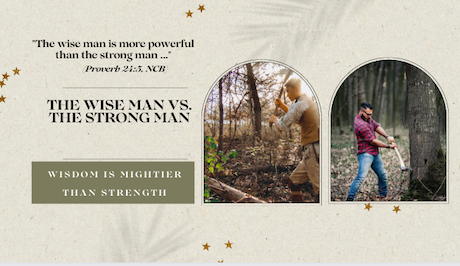
The most authoritative book in the literature of wisdom, The Proverbs, which is attributed to the wisest man to ever live - King Solomon - declared the following maxim about the wise and the strong: “The wise man is more powerful than the strong, and the man of knowledge adds to his strength.” (Proverb 24:5, NCB). 


In response to that passage of scripture, I have composed a poem in order to try to elaborate on its message.  


Wisdom is Mightier than Strength - A Poem:


Wisdom, the mightiest force of all

It conquers mountains, breaks through walls

A weapon stronger than swords or shields

It breaks the chains that bind and yield


Might may make men seem great and grand

But it's wisdom that commands the land

It guides us through life's stormy seas

A light that shines with elegance and ease


In wisdom we find a strength divine

A power that is truly intertwined

With knowledge and understanding deep

It helps us climb and never sleep


So let us seek wisdom in all we do

For it will guide us, strong and true

And though we may not be the mightiest of men

We will be rich in knowledge, and wise within


Wisdom is Mightier than Strength in the Context of the Corporate World:


In the cutthroat world of multi-national corporate, it's easy to get caught up in the pursuit of power and strength. We're told that we need to be the biggest, the baddest, the most dominant player in our field in order to succeed. But is that really true?


Before I delve into the analysis, the above claim is not an exaggeration, to prove my point, take a look at the following summary of the popular 16th-century political treatise by the Italian diplomat and political theorist Niccolò Machiavelli called ‘The Prince’. 


JoJan, CC BY 3.0, via Wikimedia Commons


 (Niccolò Machiavelli (3 May 1469 – 21 June 1527) was a Florentine statesman, political philosopher, historian, musician, poet, and comedic playwright. Statue by Lorenzo Bartolini outside the Uffizi, Florence.)


The summary: The book is about how a prince should rule and is based on Machiavelli's personal experience as a diplomat in Renaissance Italy. The main message of the book is that a prince should be willing to use any means necessary to maintain power and control, even if it means acting immorally or brutally. Machiavelli argued that the ends justify the means and that it is better for a prince to be feared than loved. He believed that the most important characteristic of a successful ruler is the ability to maintain power and that a ruler should do whatever it takes to keep control, even if it means going against traditional moral and ethical codes.


Now, let’s get back to our objective analysis, and to start with we’ll dissect the business sector in the corporate game. As it turns out, wisdom might just be the ultimate secret weapon in this fierce game. Here's why:


  • Wisdom allows us to make better decisions. Sure, brute force can sometimes get us what we want in the short term. But over the long haul, it's the ability to think critically and make sound decisions that really pays off. Wisdom helps us avoid costly mistakes, navigate tricky situations, and make the best choices for ourselves and our businesses.


  • Wisdom attracts the right people. It's not just about being the strongest person in the room - it's about having the right team around you. And people are naturally drawn to those who exude wisdom and intelligence. When you're the smartest person in the room, people will want to work with you, learn from you, and follow your lead.


  • Wisdom helps us adapt to change. In the business world, things are always changing. Markets shift, technologies evolve, and new competitors emerge. Wisdom helps us stay nimble and adapt to these changes, rather than being left behind. It's a crucial skill to have in today's fast-paced world.


So next time you're tempted to clench your fist, flex your muscles and show off your strength, remember that wisdom might just be the better route to success. It might not be as flashy, but it will get you exactly where you want to go in the long run.


Wisdom is Mightier than Strength in the Biblical Context:


One example of wisdom being mightier than strength can be found in the story of David and Goliath from the Bible. In this story, the Philistines and Israelites are at war, and the Philistines send out their champion, Goliath, to challenge the Israelites to a one-on-one fight. Goliath is a giant of a man, strong and formidable, while the Israelites are afraid and unable to find a worthy champion to fight him.


However, a young shepherd named David volunteers to take on Goliath. Despite his small size and lack of military training, David trusts in the Lord and uses his wisdom to defeat Goliath. He chooses to fight with a slingshot and stone, rather than a sword, and uses his knowledge of the terrain to his advantage. In the end, David's wisdom and faith in God triumph over Goliath's physical strength, and he emerges victorious.


This story demonstrates that wisdom and faith can be more powerful than physical strength and military might. It also shows the importance of using one's gifts and resources wisely, rather than relying solely on brute force or fragile human strength.


The Tale of Two People: The Wise and the Strong:


The right image is adapted by permission of Senivpetro on Freepik


Two people were tasked with cutting down a large tree using an axe within three hours. One was strong, while the other was wise. As soon as the timer started, the strong one immediately began chopping away, relying on his physical strength to get the job done. However, his axe was dull and he didn't take the time to sharpen it before starting. After two hours of labor, he had only managed to cut a quarter of the tree trunk. As time passed, he became increasingly exhausted and the task became more and more difficult.


On the other hand, the wise one didn't start right away. Instead, he took some time to come up with a strategic plan for how to tackle the task effectively. He spent half an hour drawing up his plan and another hour sharpening the axe. Once satisfied with the sharp edge of the axe, he made his first stroke on the tree trunk when there was just half the time left. It only took him half an hour to bring down the entire tree and he finished with an hour to spare. He used the remaining time to treat himself to some refreshments as a reward for a job well done.


Meanwhile, the strong one was still struggling as time went on. By this point, even lifting his axe to make a stroke had become a burden. When the time was up, he had only managed to cut half of the tree trunk and had failed to complete the task. This scenario demonstrates that wisdom is indeed mightier than strength.


Here's a YouTube video translated from Russian to English by Kate Bochevar which depicts situations where wisdom showed to be much stronger than physical strength. There's an interesting story on how classical philosopher Archimedes protected his city from military invasion by applying the knowledge of his wisdom.


Share:

About Me

My photo
About Text Wisdom: Text Wisdom brings iconic phrases—“Less is more,” “Wisdom is better than strength,” “The pen is mightier than the sword”—to life through entertaining, objective explorations that uncover their hidden power. Mission: We believe wisdom is the ultimate catalyst for success. By tracing the origins and unpacking the lessons behind those timeless sayings, we empower you to think clearly, act purposefully, and live fully. What We Offer: ✅ Faithful research and objective analysis ✅ Engaging storytelling with memorable backstories ✅ Step-by-step methods to cultivate personal wisdom ✅ Actionable tips to apply insight in everyday life. Meet the Author: LM Edward, a university graduate, who has crafted a universal, step-by-step framework for wisdom drawn from literature, history, science, and philosophy. Join our community of curious learners and transform your life—because wisdom, once gained, is more precious than gold!

Money Smart: The Ultimate Financial Freedom Blueprint [Available at Amazon; Grab your Copy Today!]

Money Smart: The Ultimate Financial Freedom Blueprint [Available at Amazon; Grab your Copy Today!]
Are you tired of living paycheck to paycheck? Do you dream of a life where money is no longer a source of stress, but a tool to create the freedom you deserve? Money Smart: The Ultimate Financial Freedom Blueprint is your step-by-step guide to breaking free from financial constraints and building a life of abundance, security, and independence! Hurry up! Get your copy today, and say goodbye to poverty!

Support for Our Mission and Efforts

cards
Powered by paypal

Subscribe for All the Important Updates

Featured Post

Give Them an Inch, and They’ll Take a Mile

  Give Them an Inch, and They’ll Take a Mile : Meaning, Origin, and Why This Saying Still Stings A measuring tape stretched to one inch in ...

Categories

Recent Posts

Our Slogan

"It is through speech that wisdom is recognised ..." (Sirach 4:24, NCB)

Privacy Policy

Contact Support

Please send us an email to admin@textwisdom.com for any issue related to this blog.